
Missing the forest for the trees

There they go again. A couple of court rulings widely seen as shifting the odds on the 2026 midterm elections have the legacy political press corps falling back on its old reliable “Dems in Disarray” — rather than focusing on what’s behind the latest one-two punch to small-d democracy and turning a blind eye to facts on the ground.
Leave it to the American edition of a venerable British publication to suggest the Supreme Court’s gutting of the Voting Rights Act is just another Trump regime dirty trick to rig the vote.
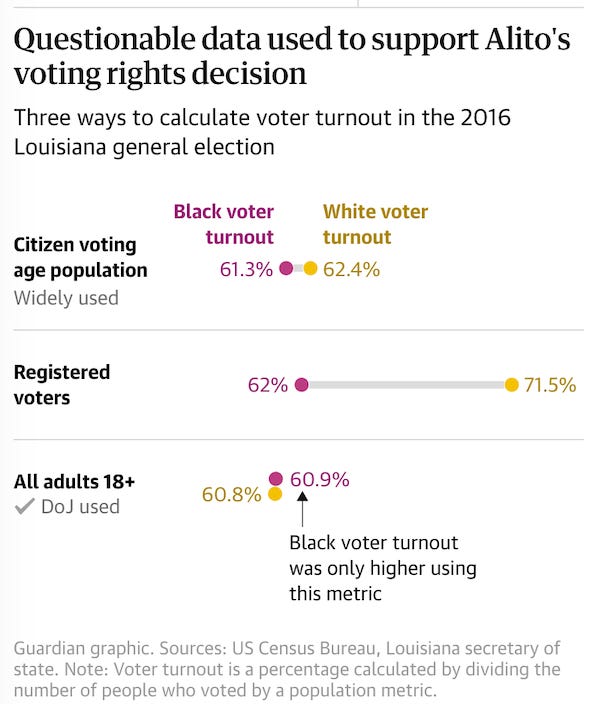
While the New York Times breathlessly chronicles “Democrats’ Desperation” over a Virginia Supreme Court’s partisan rewriting of the definition of an election, The Guardian’s New York-based staff digs deeper and reports Justice Samuel J. Alito’s majority opinion in a Louisiana redistricting case is based on what Donald Trump would call “rigged” analysis.
“Alito said that Black voter turnout had exceeded white voter turnout in two of the five most recent presidential elections, both nationally and in Louisiana. Alito’s claim was copied almost verbatim from a friend-of-the-court brief filed by the justice department. It was a critical data point Alito used to make the argument that the kind of discrimination that once made the Voting Rights Act necessary no longer exists.”
In addition to calling out what might be considered plagiarism if it were offered in an academic text, The Guardian explained the methodology peddled by the “Justice” Department, relying on a (red state) political science professor rather than unnamed sources describing political intrigue:
“[The DoJ approach] is misleading because they’re including ineligible voters in the denominator,” said Michael McDonald, a political science professor at the University of Florida who is one of the nation’s leading experts on voter turnout. “If I wanted to manipulate the numbers in a way that was favorable to the government’s interest, I would be using voting age population.”
The Guardian reports that when it analyzed turnout numbers in Louisiana using the citizen voting age population, it found that Black voter turnout in the state only exceeded white voter turnout in the 2012 presidential election.
Tellingly, the “Justice” Department would only acknowledge its methodology but decline to explain its approach. And SCOTUS did not deign to return The Guardian’s request for comment.
In contrast, the Times opted for drama and tactics over data in discussing how top Democrats considered options to overcome the separate Virginia decision:
“The conversation reflected the desperation and fury that have gripped the party after the state Supreme Court struck down a favorable map that had been ratified by voters. The most dramatic idea they discussed — which would involve an unusual gambit to replace the entire state Supreme Court, with a goal of reinstating their gerrymandered map — drew mixed reactions on the call, said the people, and it was not clear that it would even be viable, or palatable to Gov. Abigail Spanberger and Democrats in the Virginia General Assembly.”
In what passed for background and context — no mention of the SCOTUS decision and efforts in Tennessee, Alabama and elsewhere to capitalize on it — the Times offered boilerplate:
“Facing stiff headwinds, including President Trump’s low approval ratings and high gas prices, Republicans are looking for every advantage they can find to defy the odds and hold on to their narrow majority.”
Match the Guardian reporting? Perish the thought for the publication that continues to boast “All the News that’s Fit to Print.”
The Times also fell back on old, reliable anonymice to tell the tale while an upstart in the arena, The Bulwark, opted for the equivalent of old-fashioned shoe leather in this electronic age.
Tennessee-based reporter Lauren Egan didn’t quite hit the streets to speak with real voters. But she did make a round of calls to state Democratic Party officials who do listen to the folks on the ground. The message she received was hardly as dramatic — or frankly even earth-shattering. Just listening to people like former Mississippi party chair Rickey Cole:
“I live in lily-white Mississippi. You can believe in civil rights and you should believe in civil rights. I believe in civil rights. But it ain’t gonna be my topic of conversation at the gas pump with Bubba,” said Cole. “I’m gonna talk to him about something else.”
And there certainly is plenty of “something else.” Like a war and Trump’s preference to talk about his edifice complex. Corruption on a massive scale that is coming out of taxpayer pockets. Not to mention:
“{A]bout 7 in 10 Americans say Trump is not honest and trustworthy, two-thirds say he does not carefully consider important decisions and about 6 in 10 say he does not have the mental sharpness to serve as president. Over half say Trump is not in good enough physical health to serve effectively as president (55%) and that he is not a strong leader (54%).”
It falls to Democrats to talk about those issues — and journalists to cover them. The problem is the hollowing out of local news by corporations that value profits over serving communities leaves many would-be voters at the mercy of a national political press corps that eschews real issues for the horse race polls and fundraising. And backroom maneuvers.
Perhaps that esteemed group of reporters still focusing on whether to reschedule its annual tribute to itself can cast on eye on polls that don’t try to predict winners and highlight issues increasingly on the minds of voters.